The workflow builder, and the five decisions inside it
On this page
Workflow builders get judged on how fast you can get the first thing working, which is a terrible benchmark, because the first thing always works. Every tool in this category nails the first five minutes. That is what the first five minutes are for.
The question I care about is day forty. The flow has eleven nodes now. There is a loop. There is a retry that fires maybe twice a week for reasons nobody has fully established. The person who built it has moved teams, and someone else is on call at 2am looking at it for the first time.
Five decisions in Tamtree’s builder are aimed at that person at 2am.
1. A ladder, not a wall
The usual shape of a visual builder is a lovely garden with a cliff at the edge. Everything is delightful until you need the one thing the canvas cannot express, and then the answer is “write a service”. You have gone from dragging boxes to provisioning infrastructure in a single step, and there is nothing in between.
A ladder is the better shape, where every rung is a smaller step than the cliff it replaces:
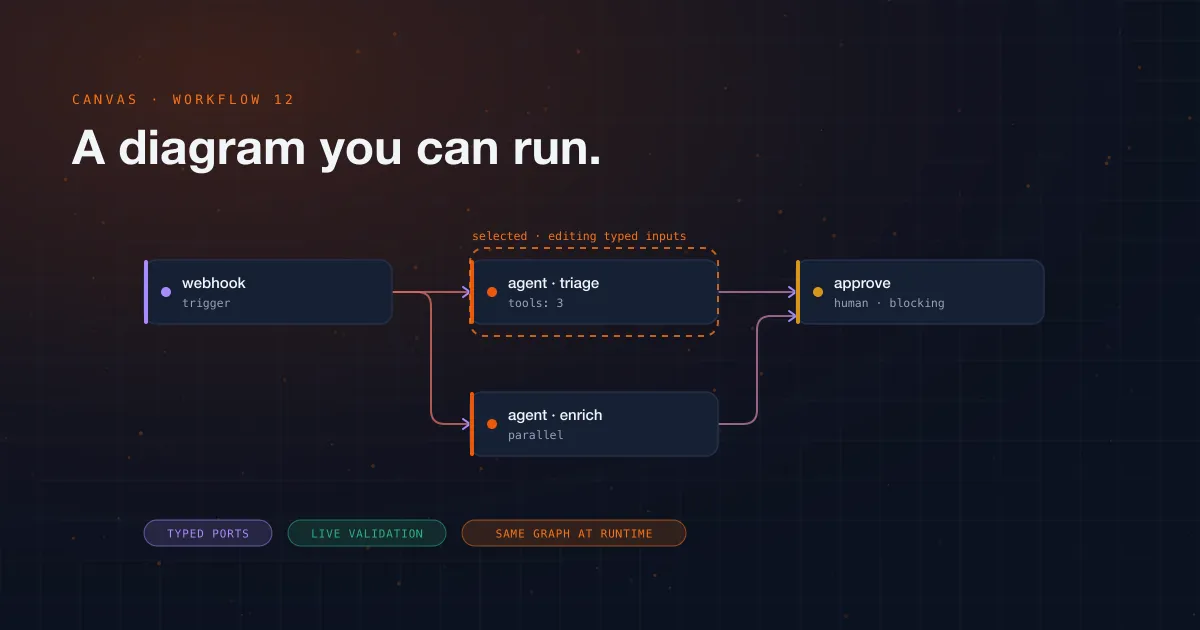
- Visual editing — the canvas, trigger-first, each node configured against real input data.
{{ }}expressions — reach into a prior node’s data without leaving the field you are typing in.- Code nodes — sandboxed Python or JavaScript, for the transformation the expression language deliberately refuses to do.
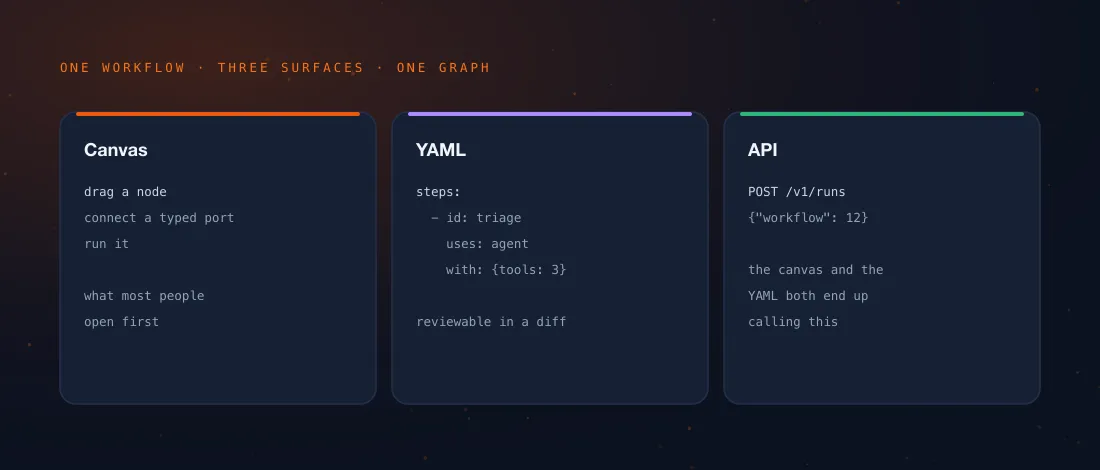
- The Python SDK — author your own nodes and tools as first-class citizens, not as HTTP calls to a service you now have to operate.
- Git sync and the CLI — the flow is text, reviewable in a pull request.
- The full REST API — everything the UI can do, available to a program.
The important property is that no rung makes you abandon the one below it. A flow that reaches for the SDK on one node keeps the canvas for the other ten. That is the whole idea, and it is exactly what a “just write code instead” escape hatch fails to give you — because that hatch is not a rung, it is the cliff with a handrail.
2. An expression language that says no on purpose
{{ }} expressions resolve against prior node data: $json for the current
item, $node("Name") for another node’s output, $vars for the run’s
variables, $now, $env, and a short list of others.
The interesting part is not what it evaluates. It is the list of things it flatly refuses to.
| Allowed | Refused |
|---|---|
| Constants, whitelisted names, subscripts | Any dunder access |
| Arithmetic, comparisons, boolean operators | import, lambdas, comprehensions |
Conditional expressions (a if c else b) |
Assignment and the walrus operator |
| Calls to whitelisted functions and methods | Attribute access reaching Python internals |
It parses with ast.parse(mode="eval") and rejects unknown node types by
allowlist, never by blocklist. That distinction sounds like pedantry right up
until someone is actively trying to climb out of your sandbox, at which point it
is the only thing that matters. A blocklist is a list of the attacks you have
already thought of. An allowlist is a list of the things you meant to permit.
Only one of those gets shorter as you learn more.
# Whitelisted functions, in full. The shortness is the feature.len min max sum abs round sorted str int float bool list dict
# Whitelisted string methods.upper lower strip split join replace startswith endswith title3. Variable scoping that survives a retry
This is the subtle one, and it is where home-grown orchestrators quietly break in a way nobody notices for months.
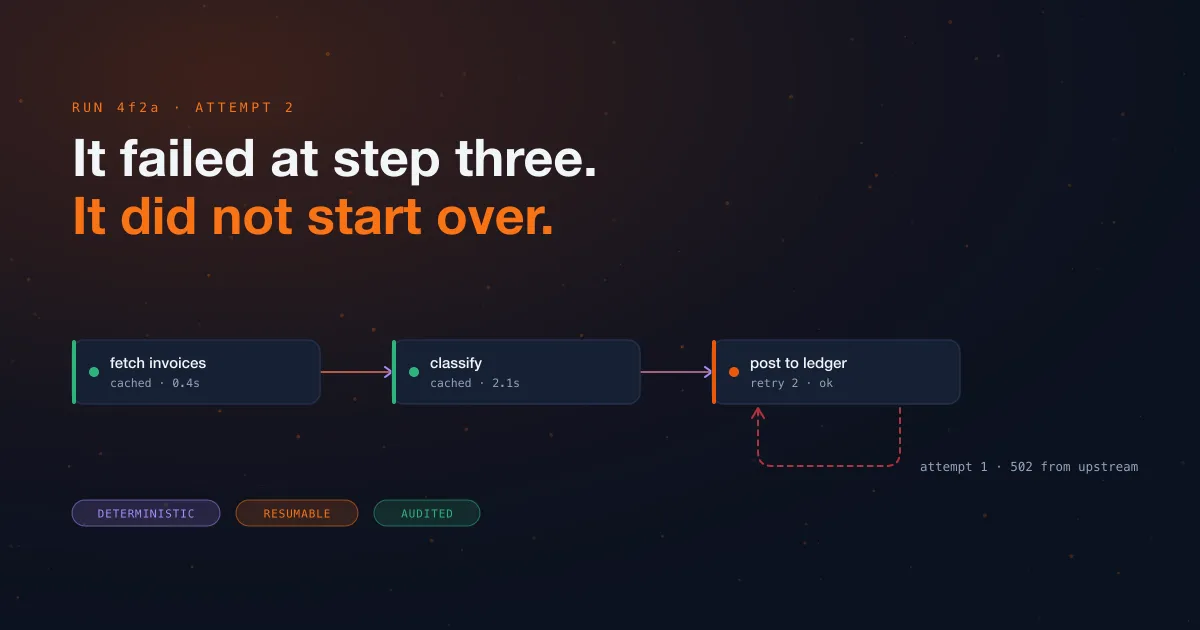
A retried step has to see what the first attempt saw. If it does not, then
{{ $vars['n'] + 1 }} increments twice on a retry, your counter is wrong, and
it is only wrong under load — which is to say it is only wrong in production, on
the days that matter, and never once on your laptop.
Snapshot at dispatch
The $vars snapshot an activity resolves against is fixed when the activity is
dispatched. A retried attempt sees precisely what the first attempt saw, which
makes the expression idempotent by construction rather than by discipline.
Writes land forward
A write becomes visible to the next node. Never to the node that wrote it, never to a node that has already run. A step that fails writes nothing at all.
Children get their own scope
Sub-workflows, crews, and every pass of a loop body start from a fresh scope built from their own declarations. They neither inherit from the parent nor write back to it.
That last one is the sort of thing you either write down in the specification or you learn at 2am. We picked writing it down.
4. Test runs that test the thing you are editing
There is a distinction here that sounds pedantic for about four seconds.
| Editor test run | Triggered or API run | |
|---|---|---|
| What executes | The draft definition | The published version |
| Payload | An optional trigger payload you supply | Whatever the trigger delivered |
| Where the payload lives | Run state — staged per run, gone when the editor closes | The trigger’s own data |
| Replayable afterwards | Yes — the draft is snapshotted into the run | Yes |
The draft gets snapshotted into the run’s input, so a test run stays replayable even after you have edited the flow underneath it. This matters more than it sounds: without it, “re-run that test from an hour ago” silently runs today’s flow against yesterday’s data and tells you nothing true about either.
And the trigger payload takes the same one-object shape the public API takes, so
{{ $json[...] }} resolves in the editor exactly as it will in production.
Anything else and your builder is a simulator with a subtly different physics
engine, which is worse than no simulator.
5. Errors addressed to the person who built the flow
Missing keys resolve to None rather than raising, because that keeps authoring
forgiving — you can wire a node up before its upstream exists. The cost is that
the failure surfaces one step later, as an operation on nothing, and the
default message for that is a classic:
'NoneType' object is not subscriptable
Which names no parameter, no expression, and no next move. It is a message written by a Python interpreter for a Python programmer, and it has been handed to a person who was, quite reasonably, dragging a box.
So the evaluator never lets an interpreter message through. It names the sub-expression that was empty — not the one that raised — rendered back in the author’s own syntax:
$json['data'] is empty (null), so ['items'] cannot be read from it field: fields.oops hint: the "Fetch order" node returned no items for this inputIt is also deliberately non-retryable. Re-evaluating the same inputs is deterministic, so a retry only delays the failure and then buries the real message under a retry-exhausted one. Retrying a typo is not resilience.
What it adds up to
Composition is the payoff. A pipeline node can be a crew; a crew can call a pipeline as a tool. Both share one run, one ledger, one guardrail policy and one set of credentials — which is only possible because they are two primitives on one engine, rather than two products with an integration between them.